The Bridge Nobody Built
When Both Drivers Want the Crash
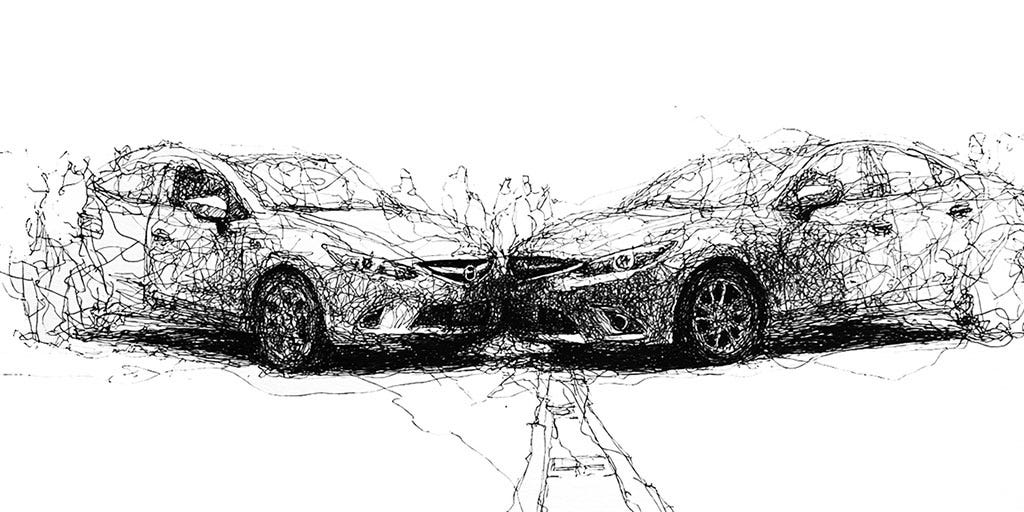
Two drivers round blind corners from opposite directions. Between them: a narrow bridge, barely wide enough for one vehicle. No time to brake safely, too much momentum to reverse. Both press the accelerator, betting the other will swerve first.
Neither does.
I wrote that analogy months ago, in The Human Thread, to explain how most wars actually start. Not with ancient hatreds or irreconcilable differences, but with bad bets about who will blink first. The underlying disputes simmer for years. What transforms tension into violence is the miscalculation: both sides betting the other will back down rather than fight.
This weekend, we watched it happen.
On Friday night, the United States and Israel launched joint strikes across Iran. By Saturday morning, Iran’s Supreme Leader Ayatollah Ali Khamenei was dead. By Sunday, Iranian missiles were hitting Israel, the UAE, Qatar, Bahrain, Saudi Arabia, Kuwait, and Jordan. Hezbollah opened a second front from Lebanon on Monday morning. The Strait of Hormuz was declared closed to shipping.
The bridge analogy holds. But something about this collision is different from the ones I described in the book. Something worse.
In the book, I traced the pattern through history. Athens and Sparta. Kennedy and Khrushchev. Each case followed the same psychology: rational leaders making rational calculations about the other side’s willingness to yield. Both sides so focused on reading their opponent’s resolve that they created the very crash they were trying to avoid.
But in each of those cases, both drivers wanted to survive. Kennedy and Khrushchev were terrified of nuclear war. Their miscalculation was about thresholds, not intentions. Both wanted to avoid the bridge. They just misjudged how close they were to it.
The Cuban Missile Crisis resolved because back-channel communication survived. A quiet deal on Turkish missiles. A letter that arrived at the right moment. The architecture of diplomacy, imperfect and fragile, provided just enough space for both drivers to swerve without losing face.
What happens when one driver doesn’t want to swerve?
Three weeks before the strikes, the United States and Iran held indirect talks in Muscat, mediated by Oman. Both sides called it a “good start.” By February 27, Oman's Foreign Minister announced a breakthrough. Iran had agreed to halt uranium stockpiling and accept full international verification. Peace, he said, was 'within reach.' Diplomatic infrastructure was being assembled. Traffic lights were being installed on the bridge. They were nearly operational.
Then someone floored the accelerator. The strikes came the next day.
The stated justification shifted from nuclear containment to regime change. President Trump released an eight-minute video announcing the purpose of the strikes was effectively to end the Iranian regime. The scope expanded from military targets to leadership compounds, intelligence headquarters, state broadcasting. Within hours, forty senior officials were dead. The Supreme Leader was dead. The commander of the Revolutionary Guards was dead.
This is not a narrow bridge moment. This is demolishing the bridge entirely.
When you publicly declare that the goal is the destruction of a regime, you eliminate every off-ramp. The normal calculus collapses, because negotiation now means surrender. And surrender means the end of everything the other side has built, believed in, and fought for across four decades.
In the book, I wrote that actual bridges solve the collision problem through engineering. Traffic lights. Yield signs. Communication systems. Protocols that prevent the crash rather than hoping rational actors will figure it out under pressure.
Every one of those mechanisms has now been dismantled. The diplomatic channel through Oman is dead. Iran’s national security council has denied any push to resume talks. The communication systems that might allow a face-saving exit have been struck along with everything else.
Iran’s remaining leadership is not operating in the framework of rational deterrence. What survives of the IRGC, the clerical establishment, the security apparatus: these are people who grew up in the Iran-Iraq war. Who built their careers around the expectation that this confrontation would come. Whose political theology includes a concept of martyrdom that is not metaphorical.
The outcome of surrender and the outcome of fighting to the end look roughly the same to the people making the decisions. When both paths lead to destruction, the path that includes inflicting maximum damage on your enemy becomes the rational choice within its own logic.
The Strait of Hormuz closure. The attacks on civilian infrastructure across the Gulf. The activation of Hezbollah. These are not the actions of a regime searching for an off-ramp. They are the actions of a regime making the cost of victory as high as possible. Because victory, for them, means annihilation regardless.
Rational actor models work when both sides want to survive. They break down when one side has concluded that survival is no longer on offer.
This was avoidable. Three weeks ago, diplomats were talking. The bridge was being built. Imperfectly, slowly, with deep mistrust on both sides. But built.
Now we have a multi-front regional war. Hezbollah firing into Israel. Iranian missiles hitting residential buildings near Jerusalem. Gulf airports damaged. Oil shipments frozen. Three American soldiers dead. Over five hundred Iranians dead, including more than one hundred and fifty children at a school. And a regime that has been told, publicly and explicitly, that its existence is the target.
It is difficult to see what brings de-escalation in the coming days. More likely, a cornered regime will deploy everything it has left. Not to win, which is impossible, but to ensure that the cost of its destruction is felt everywhere. The Strait stays closed. The missiles keep flying. The proxy networks activate. The shockwaves ripple outward into energy markets, inflation, the cost of heating your home and filling your car.
And somewhere in the wreckage, the mechanisms that might have prevented this, the traffic lights, the yield signs, the quiet channels where adversaries could step back without humiliation, lie in pieces.
We are not on the bridge anymore. We are in the river below it.
What Really Matters:
Wars don’t start with hatred. They start with bad bets about who will blink first. The most dangerous moments come when blinking is no longer an option, when one side has been told, publicly and irrevocably, that their existence is the target. The driver isn’t trying to cross anymore. They are trying to make the crash as costly as possible for everyone.
Paul Iliffe is the author of The Human Thread: What Really Matters in the Age of AI.