The Two Attics
What We Load Into Memory Now
Modern video games don’t render entire worlds at once. When you’re exploring a vast landscape, the game loads what’s immediately around you in high detail - the texture of nearby trees, the individual stones on the path, the expressions on characters’ faces. Mountains in the distance remain low-resolution silhouettes. Turn a corner, and suddenly those distant forms load in detail while what you left behind fades to outline.
This isn’t a limitation of the technology. It’s efficient design. Loading everything at once would slow the system to a crawl. The game needs to make constant decisions about what deserves high resolution and what can stay blurry until needed.
Your brain has always worked exactly this way. You hold certain knowledge in high resolution - your address, your partner’s name, how to make tea, the plot of your favourite film. Other information remains accessible but low-resolution until you need it. The capital of Peru? You could find out. The date of the Battle of Hastings? Retrievable if necessary. But these facts don’t need permanent space in your active memory.
For most of human history, this rendering distance was determined by practical necessity. What you used regularly stayed sharp. What you rarely needed faded. The system maintained itself through use and neglect, retrieval and forgetting. But something fundamental has shifted. For the first time in history, you have to consciously decide what deserves to be rendered in high detail in your mind versus what can live in the vast, perfect storage of digital systems.
We’re living through the emergence of what you might call the two-attic problem.
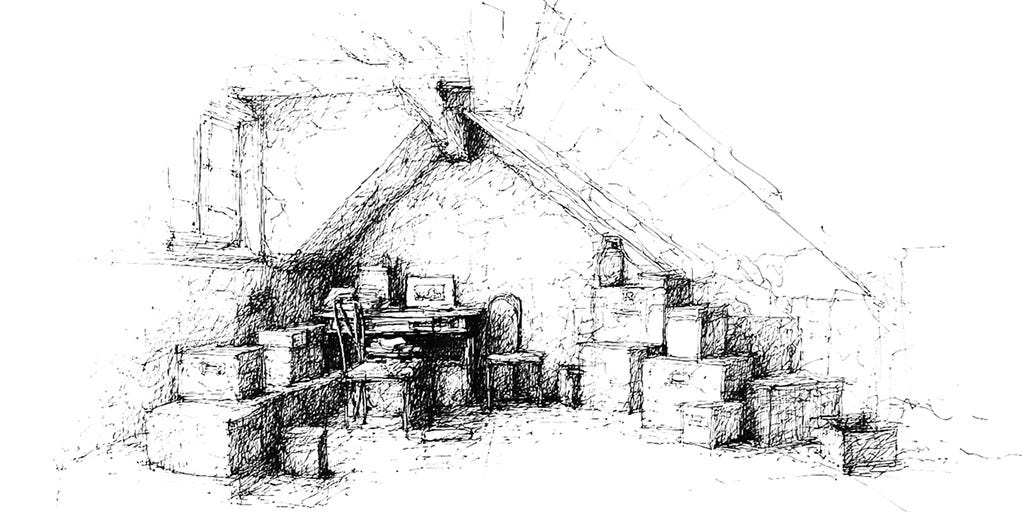
Climb the narrow stairs to your attic, flashlight in hand. Decades of family life are scattered across the floorboards. Some boxes have collapsed from damp, their contents lost. Other treasures have survived purely by chance. You find wartime letters carefully preserved in their original envelopes, but university notebooks have crumbled to dust. The attic kept what mattered through a combination of deliberate storage and natural decay.
This is how human knowledge has always worked. We preserve what seems important, but time and forgetting do essential curatorial work. Important memories strengthen through retelling. Trivial details fade unless repeatedly reinforced. Even our brains don’t store memories like video recordings - they reconstruct them each time, emphasizing what seemed significant and letting peripheral details blur.
Libraries understood this principle. The best librarians don’t just acquire books - they “weed” their collections, removing materials that no longer serve readers. This isn’t censorship. It’s curation. It’s understanding that attention is finite and context changes. Medieval libraries practised intentional forgetting too. Manuscripts that weren’t copied regularly would fade from circulation, while texts deemed valuable were preserved through the labour of copying. Islamic scholars developed elaborate systems for classifying hadith - the recorded sayings and actions of Muhammad - by reliability, letting unreliable accounts fade from use while authoritative ones remained in circulation. West African griots - professional storytellers and oral historians who preserved their communities’ histories through memorisation and performance - relied on repetition as their curation system. Stories that weren’t worth retelling simply vanished from collective memory, while essential histories were passed down through generations with remarkable precision.
The principle endures across cultures and centuries because forgetting serves knowledge, not just memory. When trivial details fade, underlying patterns become visible. When old information decays, new connections can form. When yesterday’s certainties dissolve, space opens for fresh insight.
The attic worked because it had natural limits. Space was finite. Materials decayed. Time did the curatorial work that we couldn’t always do ourselves. The system forced choices about what deserved preservation.
Now we have two attics.
The first attic - your mind - still operates under the old constraints. Limited capacity. Things naturally fade without use. Maintenance requires energy. But retrieval strengthens memories. Using knowledge keeps it accessible. The architecture hasn’t changed.
The second attic - digital storage - operates under completely different rules. Unlimited capacity. Nothing fades. No maintenance cost. Perfect recall. But retrieval doesn’t strengthen anything. The information just sits there, equally accessible whether you use it daily or never at all. Every trivial detail is preserved with the same fidelity as your most important memories.
For the first time, you have to consciously decide what lives where.
This isn’t just a personal question. It’s a generational one. People who grew up before digital abundance developed their mental attics during an era when external storage was expensive and slow. You memorised phone numbers because looking them up was inconvenient. You internalised basic geography because reaching for an atlas was friction. You held historical dates in memory because the alternative was a trip to the library. Scarcity forced you to load more into your mental attic, because the external attic was slow and incomplete.
People growing up now face different constraints. When any fact is three seconds away, the calculation changes. Why dedicate permanent mental storage to information that’s instantly retrievable? The same cognitive capacity could hold patterns, frameworks, principles - knowledge that actually benefits from being in your head rather than in a search engine. They’re optimising differently. A teenager might not hold the names of the world’s oceans in permanent memory, but they can edit a photo in seconds, navigate complex emoji grammar to convey precise emotional nuance, understand layered irony in video formats you’ve never heard of or debug a Wi-Fi connection faster than you can describe the problem.
Neither approach is wrong. They’re optimised for different information environments. But there’s a catch that reveals itself slowly.
When everyone had limited mental storage, scarcity forced us all to remember roughly the same foundational things. The Second World War ended in 1945. The Earth orbits the Sun. Paris is the capital of France. This wasn’t planned coordination. It was the natural result of limited capacity and shared cultural transmission. The most essential information - essential as defined by your culture and era - occupied everyone’s mental attic because there simply wasn’t room for radical customisation.
This created instant shared ground. You could reference basic facts and assume comprehension. You could build arguments on common foundations. You could communicate efficiently because you shared a baseline of internalised knowledge.
Now that storage is infinite and retrieval is instant, we each optimise for our own needs. Your mental attic reflects your work, your interests, your algorithmic recommendations, your social circles. Mine reflects different inputs entirely. We might have zero overlap in our foundational knowledge - not because either of us is ignorant, but because we’ve made different decisions about what deserves permanent mental storage.
Common ground has to be consciously built rather than automatically shared. When you discover someone doesn’t know which ocean lies between Europe and North America, it reveals not their failure but the new architecture we’re building together. The shared baseline that scarcity once enforced is dissolving.
There’s another catch. You can’t spot patterns in information you don’t hold in memory. Insights emerge from seeing connections between things you can simultaneously access in your working memory. A historian notices parallels between the fall of Rome and contemporary events because both are loaded in their mental attic. A doctor recognises a rare syndrome because they hold enough cases in memory to see the pattern. A writer finds the perfect metaphor because diverse knowledge occupies the same mental space and forms unexpected connections.
Outsource everything to external storage, and you might lose the density of knowledge required for original thinking. Retrieval is not the same as having something loaded and active in your mind. You can look up individual facts instantly, but you can’t easily look up the patterns between facts you haven’t yet realised are connected.
We’re the first generation consciously navigating two different attic systems. The old architecture - limited mental storage, natural forgetting, shared baselines - is still partly in place. The new architecture - unlimited digital storage, perfect preservation, customised knowledge - is now fully available. We’re learning to operate between both.
This isn’t a crisis. It’s a transition. But transitions reveal trade-offs that weren’t visible before. When information becomes unlimited, curation becomes essential. When retrieval becomes instant, the question shifts from “Can I find this?” to “Does this deserve space in my head?” When everyone customises their mental attic differently, building shared understanding requires deliberate effort rather than automatic inheritance.
Video games solved this problem through algorithmic rendering distance. They determined what needs high resolution and what can stay low until you get close. Our minds need the same conscious curation now - but the algorithm has to be our own judgement about what deserves the limited, precious space of permanent memory versus the unlimited space of instant retrieval.
The digital attic gives us unlimited storage capacity. But wisdom still comes from knowing what deserves a place in the mental attic - kept close, rendered in high detail, available for the pattern recognition and creative connection that only happens when knowledge lives inside us rather than outside us.
We don’t have this figured out yet. We’re living through the experiment. But recognising we’re operating between two attics is the first step towards using both well.
What Really Matters:
Knowledge abundance requires new curation skills - not remembering more, but knowing what deserves to be remembered at all.